Showing posts with label World War II. Show all posts

Monday, July 12, 2010

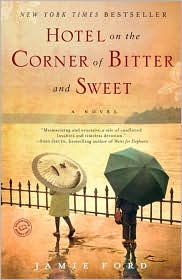
Hotel on the Corner of Bitter and Sweet by Jamie Ford

Hotel on the Corner of Bitter and Sweet by Jamie Ford is about Henry Lee, a twelve year old Chinese boy growing up in Seattle in 1942, during World War II. Henry's parents send him to an all white school where he is forced to work in the lunch room and clean the classrooms at the end of the day to earn his tuition. Henry is the only non-white student in the school... until the day Keiko, a twelve year old Japanese girl, arrives. She, too, is "scholarshipping", or working for her school entrance. Henry has grown up with a very traditional father who strongly shows his support for his home country of China, against the Japanese in the war - in fact, Henry's father forces Henry to wear a button that reads "I am Chinese" every day (the Chinese and United States were allies during WWII). Henry knows his friendship with Keiko is forbidden, but he is drawn to her anyway. Their friendship grows as they work together and walk home from school together, until the day Keiko and her family are moved to a Japanese internment camp, for "their own protection". Henry finds them at the train station and offers his button to Keiko, hoping he can save her from leaving. During her stay at the temporary camp, and her longer stay in the permanent camp in Idaho, Henry finds ways to stay in contact with his best friend. Until one day, when his final letter to Keiko is returned to sender unopened. It is at this time that Henry decides to stop defying his father, who hasn't acknowledged Henry for over two years because of his friendship with Keiko's family, and return to China to finish his schooling. It is also at that time when Henry begins dating Ethel, the woman he will end up marrying and having a son with.

This book is also about the adult Henry, sharing his grown-up story in 1986 with his son Marty and Marty's fiance, Samantha. A famous Japanese-built hotel in Seattle has been purchased, and in the basement a virtual museum of possessions found. Trunks and personal possessions from the Japanese families sent to the internment camps, stored in the basement for 40 years. Henry is sure he'll find something of Keiko's he's been searching for on and off for many years, in that basement. Struggling with feelings of guilt about his recently deceased wife, and excitement at the thought of finding Keiko again, Henry finds what he was looking for and is able to fix something he'd always thought he had broken.

This book was amazing! I read it in one day because I couldn't put it down. I loved the way the author took the story back and forth between the 1940s and 1986. I don't typically read books written for adults, but I'm glad I read this one. I think it can be enjoyed by my 6th graders, as well! Another great read about Japanese internment camps during World War II is Weedflower by Cynthia Kadohata.

Monday, June 28, 2010

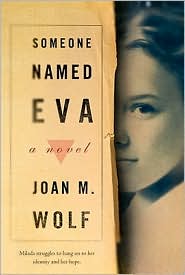
Someone Named Eva by Joan M. Wolf

Someone Named Eva by Joan M. Wolf is set during 1942 in Lidice, Czechoslovakia. Eleven year old Milada and her family are proud Czechs who do not agree with Hitler and his Nazis and are hoping for a fast end to the war. Their hopes are dashed when Nazi soldiers break into their home in the middle of the night and arrest everyone - Milada, her mother, father, grandmother, older brother and baby sister. All of the men and teen-aged boys in the neighborhood are separated and taken away, while the women and children are transported to a nearby town and held. Because she has blond hair and light eyes, Milada is selected, along with several other children, to be relocated to a Lebensborn center in Poland, leaving all of the rest of her family behind. There, Milada is forced to change her name to Eva, speak only German, and learn to "become" an upstanding German girl. Several times during her two years at this "school" Eva nearly forgets who she is and where she's from - the very things her grandmother pleaded with her to never forget as she was being taken away. Eventually, all of the girls are adopted by German families hoping to further the Aryan race. Eva works hard to remember who she truly is, despite the years it's been since she's seen her family. She prays for the war to come to an end and hangs on to the hope that she'll eventually be reunited with her real family.

This was a really good book. I actually cried at the end! The author's note was really interesting - I didn't realize the Nazis took non-Jewish, non-German children who had the right facial features and coloring and "repatriated" them as German children. This was a side of World War II I have never read about.

Saturday, May 15, 2010

Tropical Secrets: Holocaust Refugees in Cuba by Margarita Engle

Tropical Secrets: Holocaust Refugees in Cuba by Margarita Engle is about Daniel, a young Jewish boy sent alone by his family on a ship to Cuba to escape the Nazis. Daniel finds that Cuba is not very welcoming to the refugees. In fact, the only two people who seem to be kind to him are David, an old man, and Paloma, the daughter of one of the richest and most powerful men in Cuba. Paloma's father is the one who decides how much to charge in "fees" for refugees to be able to enter Cuba. It's his decisions that determine whether the refugees will be allowed to leave the ships and live in Cuba, or will be turned away and have to go back to Europe. Cuba was the last hope for many of these refugees. Paloma is determined to help them, however, by offering them kindness, food, and even a safe place to hide up in her dovecote ( a tower where she keeps doves). Daniel struggles with the realization that his family is probably never going to join him in Cuba, but overcomes his sadness when he finds a young boy named Daniel, his namesake, to take under his wing.

This was an interesting story. I didn't realize that so many Holocaust refugees ended up in Cuba. I also had no idea that Cuba was the last stop (after other North American countries) for the refugees and that they were sent back to Europe if Cuba wouldn't accept them. This story is told in free verse through the eyes of Daniel, David, Paloma, and sometimes even Paloma's cruel father. I really enjoyed this story and learned a lot about a part of history I didn't know much about before. I recommended this book to a student immediately after finishing it, and she's really enjoying it, too!

Sunday, April 11, 2010

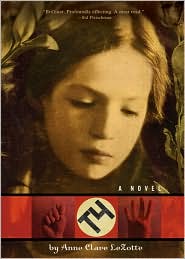
T4: A Novel in Verse by Ann Clare LeZotte

T4: A Novel in Verse by Ann Clare LeZotte is the story of Paula Becker, a young German girl who became deaf as a baby after an illness. Paula and her family struggle to learn different ways to communicate, but eventually fall into a routine - even her beloved dof figures out ways to communicate with her! Paula has to go into hiding, however, when Hitler began his campaign for creating the "master race". During the Holocaust, Hitler and the Nazis not only gathered and killed many Jewish people and Gypsies, he also signed a secret order to have doctors kill people living with disabilities. This program was known as T4. Paula had help from Father Josef and escaped the city for various safer places, always moving when the SS came too close to discovering her. At a homeless shelter, Paula meets Poor Kurt, an old man who slept and ate there every night. They decide to go out on their own to help other people who were suffering at the hands of Hitler and the Nazis. All does not go as planned, however, and they end up back at the homeless shelter. When the war ends, Paula returns home to her family and brings Poor Kurt with her. After he cleans up and shaves, Paula sees for the first time that Kurt, who is actually Walther, part Romani or Gypsy, is only 3 years older than she!

WOW! This was a great book! Because this book is written in verse, it is a quick read. I had never heard of the T4 program before and I am shocked and saddened by it. This book did an excellent job of describing Paula's experience and the facts behind Hitler's terrible plan, while keeping it all appropriate for a young audience. I was glad for the happy ending!

Saturday, March 13, 2010

The Dog in the Wood by Monika Schroder

The Dog in the Wood by Monika Schroder is set in Germany just after Russia invaded at the end of World War II. Ten year old Fritz lives with his grandparents, mother, sister on his grandparents' farm. They've lived there ever since Fritz's father was killed in the war. Fritz's grandfather is a NAZI sympathizer and is convinced that he and Fritz will need to fight for the farm when the Russian soldiers arrive. Fritz is terrified - he wants to do what his grandfather tells him to do, but he isn't sure he is courageous enough to fight. He takes solace in carving his little wooden dog in the barn, with Lech, the Polish hired hand. But, Fritz doesn't have to fight alongside his grandfather - when news comes that the Russian soldiers have arrived, Fritz's grandparents commit suicide. Then, the townspeople and the soldiers force Fritz and his family (including Lech) to give up their farm! They have to travel with just a small cart, leaving most of their possessions and livestock behind, to their other grandmother's house in the south. When they arrive, things go from bad to worse... the Russian soldiers come to arrest Fritz's mother on weapons charges - even though she has no weapons! Trying to defend her, Lech is also arrested. Now it is up to Fritz to save them... can he do it in time?

This was a great book! I've never read a book about WWII from the perspective of a German civilian. It was a very interesting look at what happened to regular people that got caught up in the war while just trying to survive. The author's note at the end was also quite interesting. Much of this story was based on events from her own father's childhood!

Sunday, December 20, 2009

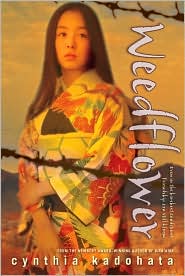
Weedflower by Cynthia Kadohata

Weedflower by Cynthia Kadohata is set in the United States, just before and right after the bombing of Pearle Harbor. Sumiko and her brother, Tak Tak, lost their parents in a car accident several years before. Since then, they have been living with their aunt and uncle in California, working on their family run flower farm - their specialty? Kusabana, or weedflower. When Pearle Harbor was bombed, all of the Japanese people were suspected of being spies for Japan and were rounded up and sent to different internment camps around the United States. Sumiko's uncle and grandfather were seen as leaders of their community and were sent to North Dakota. The rest of the family, Sumiko and her brother, their aunt and two cousins, were sent to Poston, Arizona. This internment camp was on an Indian Reservation. It was hot, dusty, and hostile - like nothing Sumiko had ever experienced before. Everyone in the camp tried to make the best out of the situation by trying to work, planting gardens, starting a school, and even developing sports teams! The work was hard and paid very little. Sumiko met an Indian boy named Frank who was interested in the ways her cousins irrigated their little flower farm back in California, and wanted to learn more about it. She arranged the meeting. Eventually, the Japanese people were asked to relocate again, this time to places outside of camps so they could contribute to the workforce within the United States. They were also asked to sign up to fight in the war on the side of the US. Anyone who refused to agree that they were loyal to the US and not Japan, was sent to a "segregation" camp. Sumiko's older cousins both went to the military, and her aunt decided to move everyone else to Chicago to look for work. Sumiko hated this decision, because she finally felt like she belonged somewhere.

This was a really good book. I learned a lot about the history of both the Native Americans who lived on the reservation in Poston, Arizona, as well as the history of the Japanese people who were living in the US during WWII. The author, Cynthia Kadohata's father was a prisoner at the camp in Poston. His experiences contributed to those described in the story.


Iowan to Receive her Dream Degree
The above link is to a news story out of Ames, Iowa about a woman whose husband worked with my dad for many years. It is about her story and experience living in the Japanese Internment Camp in Arizona.

Friday, August 21, 2009

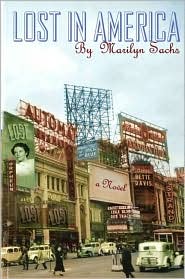
Lost in America by Marilyn Sachs

Lost in America by Marilyn Sachs is about Nicole, a young Jewish girl living in France during World War II. One night she stays over with a friend, and her parents and younger sister are taken by Nazis. Nicole finds herself alone and no one will help her. She eventually stays at her school until it closes. Then, she tries to stay with her aunt, in hopes that her family will soon return. Her aunt ruins her parents' apartment with ugly paint and furnishings, and allows her boyfriend to move in. Then, she learns that her parents and little sister were killed at a concentration camp. As a result, Nicole decides to follow her best friend, Rose, to America to stay with a cousin. Life in America is hard for Nicole. It is busier, louder, and less friendly than the small town in France where she was from. Her clothes are not right, she doesn't understand English very well, and has a hard time speaking to Americans. Her new family is very unpleasant to her, forcing her to get a job and pay rent! Nicole uses this first year in America to find new friends and learn the ways of the Americans.

This story was based on the actual events in the life of the author's close friend. She described her first year in America as the best and worst year of her life! The history in this book was interesting. I have never read a book from the perspective of a person who was touched by WWII in this way. This was a great historical fiction novel!

Friday, March 13, 2009

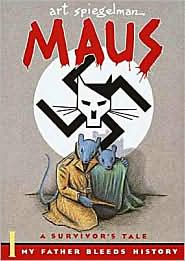
Maus: A Survivor's Tale: My Father Bleeds History by Art Spiegelman

Maus: A Survivor's Tale: My Father Bleeds History by Art Spiegelman is a graphic novel about a Jewish man and women surviving in Poland during WWII. In this story, The Jewish people are represented by mice and the Germans by cats. The story starts out with Art Spiegelman (representing the author) interviewing his father about his experience during the war. The story goes back and forth from past to present - the past being told by Mr. Spiegelman and the present through the eyes of Artie, his son.

I really liked this book. It is the first 1/2 of the story. It ends just when Mr. Spiegelman and his wife are sent to Auschwitz after year of hiding from the Nazis. The second 1/2 of the story is a separate book called Maus : A Survivor's Tale Volume 2: And Here My Troubles Began. I haven't read this one yet, but I will. Graphic novels are not my favorite genre - I either forget to read the words or forget to look at the pictures, and then I'm lost! I found this book easier to understand. The story is funny and sad at the same time. I believe it is meant for a more mature audience, however, because of some violence.

Sunday, November 30, 2008

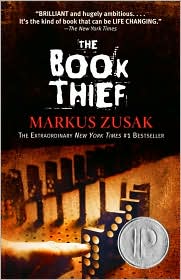
The Book Thief by Markus Zusak

The Book Thief by Markus Zusak is about about Liesel Meminger, a young German girl trying to find her place in the world during WWII. Her mother had to turn Liesel and her brother over to live in a foster home. On the train ride to their new home, Liesel's brother died. The image of him laying on the seat beside her haunts her through the remainder of the story. It is at his funeral that she steals her first book - The Grave Digger's Handbook. She arrives at her foster home alone, with not much more than this book, which she hides under her bed, unable to read it. Her new foster parents are an interesting pair, and Liesel immediately bonds with her Papa. When she is awakened by the recurring dream of her brother's death every night, Papa takes this time to teach Liesel how to read, using The Grave Digger's Handbook. Eventually, a person from Papa's past arrives, causing much hardship for the family. Max is the son of Papa's friend from the war. Max is Jewish, and is hidden in their basement for a long period of time. Liesel and Max become very close during this time. Max even uses the pages of his book about Hitler to write his own book for her. Unfortunately, Papa makes a big mistake that forces Max to leave the house, for fear of the safety of them all.

This was an excellent book. The narrator is Death, which makes the story even more interesting! I usually have a hard time reading stories that take place during WWII because of the ghastly things people did to other people. This book, however, was not difficult to read at all. The author did not make light of the atrocities done to the Jewish people during Hitler's reign, but it was told in such a way that was not too upsetting. There were so many elements within this story that came full circle and were resolved in the end. It was incredibly powerful!

Monday, September 8, 2008

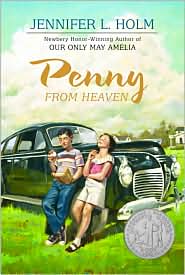
Penny from Heaven by Jennifer L. Holm

Penny from Heaven by Jennifer L. Holm is about Penny, an Italian American girl living in the United States during the 1950s, just after WWII. She is torn between her American family that she lives with (her mother, grandmother and grandfather) and her Italian family (her Nonny, uncles, aunts and cousins). Penny's father died when Penny was little and no one will give her a straight answer about how. Penny and her cousin, Frankie, get into all kinds of trouble together over the summer. Unfortunately, while searching for their grandfather's hidden treasure in Nonny's basement, Penny has a terrible accident that lands her in the hospital. This turn of events actually brings both halves of her family closer and brings Penny closer to the truth about her father.

This wasn't my favorite book. It was a little hard for me to get through. I found it a bit slow. I did enjoy the historical portions about the relationship between the Italians and Americans right after WWII, however. The author's note at the end was also very interesting, as this story was based on the author's family.

Monday, September 1, 2008

Alone on a Wide Wide Sea by Michael Morpurgo

Alone on a Wide Wide Sea by Michael Morpurgo is about six year old Arthur, a boy sent from England to live in Australia after he is orphaned during WWII. He is separated from his sister, Kitty, and only has a key to remember her by. As he grows older, Arthur eventually forgets what the key goes to, and begins to believe that he may have even made up his sister in his mind. He is sent to live and work under the harshest of conditions with numerous other orphans on a farm in Australia. Eventually, he and his friend Marty are able to escape and live through young adulthood with a women in the Australian bush, helping her save and release hurt and orphaned animals. Through twists and turns, Arthur ends up working at a boat company in New Zealand and discovers a love for the sea. He transfers this love to his daughter, and they hatch a plan to sail their own boat to England to find his long lost sister, Kitty and finally discover the true meaning behind the key that Arthur still wears around his neck.

I absolutely loved this book. The first part of the story is told through Arthur's eyes, as a sort of memoir. Although it is fiction, it is very easy to believe that Arthur truly exists and that the reader has the unique opportunity to see his life and story through his eyes. The second part of the story is told in a similar way through the eyes of his daughter, Allie. This details her journey to England and what she finds when she finally arrives. I laughed out loud at parts of this and cried along with Allie during a particularly heart wrenching experience at sea. This is one of my favorites!

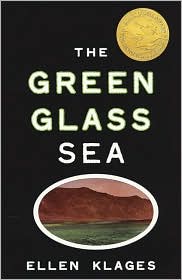
The Green Glass Sea by Ellen Klages

The Green Glass Sea by Ellen Klages is about 10 year old Dewey, the daughter of a scientist working on a top secret project for the U.S. government during WWII. After her grandmother has a stroke and is put into a home, Dewey goes to live with her father at the "Hill," a place that is so secret that it technically doesn't even exist. Many scientists live there and work on the "gadget" this is supposed to stop the war once and for all. Included among the scientists are Robert Oppenheimer and Richard Feynman. None of the kids who live at the Hill know what the scientists are working on, just that their parents are at the lab more than they are at home and that whatever gadget they are creating is important to the government.

I really enjoyed this book. It was recommended to me by a student and I can't wait to visit with her about it! Anyone who knows about the history of WWII knows that these two scientists were involved with creating the first atomic bomb, which eventually was dropped on Hiroshima, Japan at the end of the war. This book was really interesting because as the reader, I knew more than the characters about what would happen with the "gadget" and the consequences of using it on Japan. The main characters, Dewey and Suze were just trying to get through their own daily struggles as girls growing up during the 1940s on a top secret military base. They had the same types of experiences as girls growing up now - bullies, new friendships, family problems, etc.

Friday, August 1, 2008

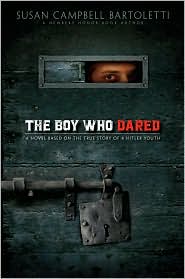
The Boy Who Dared by Susan Campbell Bartoletti

The Boy Who Dared by Susan Campbell Bartoletti is about Helmuth, a young German boy growing up during WWII. Helmuth becomes increasingly troubled with the ways people are being treated by Hitler and the Nazi's, so he starts to do something about it. He uses a short wave radio his brother left behind when he went off to battle, to listen to the British broadcast of the war. This information completely differs from the information the German radio broadcast gives, which is the only radio broadcast that is legal. Helmuth begins creating leaflets with the new information and distributing them across the city of Hamburg, Germany, with the help of his two best friends, Rudy and Karl. Eventually they get caught by the Gestapo and endure hours of torture. Helmuth is sentenced to death after taking all of the blame, and Rudy and Karl each get prison sentences.

This was a very good book. It is historical fiction, in that the author created some of the thoughts, conversations, and internal dialogue for the characters, but it is based on a real person. Susan Campbell Bartoletti got much of her information for this book from interviewing Karl and Gerhard (Helmuth's older brother). The story is told in flashbacks, which makes it seem as though there are two different stories combining at the end.

Wednesday, July 9, 2008

Soldier Boys by Dean Hughes

Soldier Boys by Dean Hughes is a historical fiction novel set during WWII. It tells the story of Dieter, a German teen who desperately wants to fight for his country, and Spence, an American teen who feels equally as passionate about defending Germany. Both boys sign up for the war before they are of age and have to justify their reasons to many family members and friends before joining. The story is told separately, through each boys' eyes until the end when they meet on the battle field.

I am not the biggest fan of war books, but this one was very well written. I really liked the way Dean Hughes showed how the boys, despite fighting on opposite sides of the war, were really very much alike. War, it turns out, is not what anyone expects once they're fully immersed in battle. It takes courage, heart, and dignity to make it through. This is one of the 2008-2009 Maud Hart Lovelace Nominees.